AI-Powered BDI Insights: Beyond Basic Scores
You have just finished your BDI test and received your score. Perhaps the number is a 15, or maybe it is a 32. But what does that number actually mean for your daily life? What if you could gain a deeper, personalized understanding of what those responses truly mean? A standard score tells you the severity of your mood state. However, it does not always explain the "why" or the "how" behind your feelings.
Thanks to breakthroughs in AI, we can now uncover deeper insights from your test results than ever before. Here at Bditest, we provide a validated BDI test that gives you more than just a simple number. With AI-powered analysis, your answers transform into a roadmap for better mental health. In this guide, we'll explore how AI is revolutionizing depression screening and how these insights can help you take meaningful steps toward better mental health.

Whether you are checking in on your own mental health or you are a professional looking for better tools, understanding the nuances of these scores is essential. Let’s explore how AI is taking the traditional Beck Depression Inventory into the future.
How AI Enhances Traditional BDI Analysis
The Beck Depression Inventory (BDI) has been a gold standard in psychology for decades. It uses 21 questions to measure symptoms like sadness, guilt, and loss of sleep. Traditionally, a person simply adds up the points to get a total score. While this is helpful, it treats every symptom as having the same weight. AI changes this by looking at the relationships between your answers.
This modern approach moves beyond simple arithmetic. It recognizes that mental health is a complex web of interconnected symptoms. By analyzing how one answer relates to another, technology provides a more holistic view of your current state.
Beyond the Numbers: Pattern Recognition in Your Responses
AI is excellent at finding patterns that the human eye might miss. When you use our online tool, the AI does not just see 21 separate answers. It sees "symptom clusters." For example, it might notice a specific trend in your results. Your overall score might be moderate, but your physical symptoms, like fatigue and appetite change, could be much higher than your emotional symptoms.
This pattern recognition helps identify the specific nature of your current mood state. Some people experience "cognitive-affective" depression. This is where they feel heavy guilt and hopelessness. Others experience "somatic" depression, where the body feels heavy and tired. By identifying these patterns, AI provides a much clearer picture of your internal experience. This level of detail helps you move past a simple label and toward real self-awareness.
The Science Behind AI-Powered Depression Assessment
You might wonder how a computer can understand human emotions. The science behind this involves machine learning algorithms. These algorithms are trained on thousands of anonymized data points. They learn how different symptoms often appear together in clinical settings.
By comparing your responses to these vast datasets, the AI can provide a high-level analysis. This analysis mirrors professional clinical logic. It is important to remember that AI complements professional judgment rather than replacing it. The technology acts as a powerful screening assistant. It takes the validated methodology of the BDI and applies modern computing power. This ensures the interpretation is as accurate as possible. This makes the screening process more robust and provides a stronger starting point for anyone looking to understand their mental health.
What to Expect in Your AI-Enhanced BDI Report
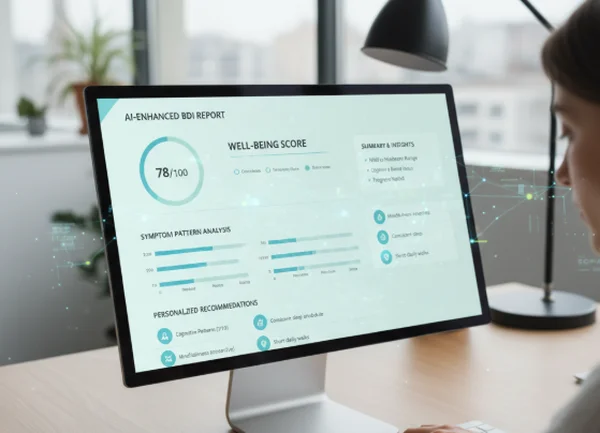
When you choose to receive an AI-enhanced report after taking your test, you are getting a personalized document. It is designed specifically for clarity. Unlike a standard result page that only shows a bar graph, these personalized reports break down your mental state into manageable sections.
Personalized Symptom Pattern Analysis
The core of the report is the symptom pattern analysis. Instead of just saying your score is high or low, the AI explains which specific areas are driving that score. It might highlight several key areas:
- Cognitive patterns: Are you struggling with self-criticism or indecisiveness?
- Emotional patterns: Is sadness the primary driver, or is it a loss of interest, also known as anhedonia?
- Physical patterns: How much are sleep disturbances and fatigue affecting your overall score?
By seeing these categories clearly, you can pinpoint exactly what feels most difficult in your life right now. This makes the data feel much more personal. It relates directly to your actual day-to-day experience.
Contextual Recommendations for Mental Health Improvement
Information is most valuable when it leads to action. Our AI generates tailored suggestions based on your specific response patterns. If the AI detects high levels of social withdrawal, it might suggest small steps for social reconnection. These steps are designed to be manageable. If it identifies high levels of physical fatigue, it might recommend focusing on "sleep hygiene" or gentle movement.
These are not medical prescriptions. Instead, they are contextual suggestions meant to empower you. They give you a "first step" to discuss with a doctor. You can also implement them in your self-care routine. Having a few evidence-based ideas can make the path to feeling better seem much less overwhelming.
Visualizing Your Progress Potential
One of the most exciting features of AI analysis is the ability to visualize progress. The report often includes "personalized improvement pathways." This section uses data to show how addressing one core symptom might help. For example, improving sleep might have a positive "ripple effect" on other symptoms like irritability or concentration.
Visualizing your mental health as a dynamic system is incredibly helpful. It is better than seeing it as a fixed state. It reminds you that change is possible. By seeing how different parts of your mood are connected, you can feel more motivated. This encourages you to engage in small, positive changes every day.
Interpreting Your AI-Generated Insights
Getting a detailed report is one thing. Knowing how to use it is another. Interpretation is the bridge between data and healing. When you start your test, keep in mind that the results are a tool for self-discovery.
Understanding Your Personalized Risk Factors
The AI looks at specific risk factors based on how you answer certain high-weight questions. For instance, questions about hopelessness or self-harm are flagged with extra care. The report will explain what these responses mean in a statistical context.
Understanding these risk factors helps you stay safe and informed. It provides a "reality check" on the seriousness of your symptoms. The AI compares your answers to clinical benchmarks. If the AI identifies significant risk factors, it will clearly highlight the importance of seeking immediate support. This objective perspective can be vital for those who might be downplaying their own struggles.
Making Sense of AI-Generated Recommendations
It is easy to feel overwhelmed by a list of things to "fix." When reading your AI insights, prioritize the recommendations that resonate most with you. You do not have to follow every suggestion at once.
The AI might suggest five different areas for improvement. You should look for the one that feels most achievable. For example, the report might suggest both "starting therapy" and "trying a daily walk." You might start with the walk today. Meanwhile, you can research therapists for next week. Use the report as a menu of options rather than a list of demands.
When to Consult a Professional About Your AI Insights
This is the most critical part of using any online tool. AI is a screening and insight tool, not a doctor. If your AI report indicates moderate to severe patterns, it's time to consult a licensed mental health professional. You can print your AI-enhanced report to bring to your appointment.

This gives your healthcare provider a head start. Instead of spending the first 20 minutes trying to explain every symptom, you can show them the data. It helps bridge the gap between your feelings and professional clinical language. This makes your first consultation much more productive and focused on your recovery.
Your Next Steps in Leveraging AI-Powered Depression Insights
Today's technology offers us something remarkable: a clearer window into our emotional landscape than previous generations ever had. A standard BDI score is a great first step. However, AI-powered insights allow you to go much deeper. By recognizing patterns, visualizing progress, and receiving tailored suggestions, you turn a simple test into a powerful tool for change.
The more we understand ourselves, the richer our lives become. Taking the time to understand your mood is an act of courage and self-care. If you are feeling stuck or simply curious about your mental well-being, don't settle for just a number.
Take the first step toward clarity today. Use our validated tool to get started and see what your scores really mean. Whether the results give you peace of mind or the nudge you need to seek professional help, you will be moving forward. You will have the power of data and technology on your side.
The Takeaway
How accurate are AI-powered BDI analysis compared to professional interpretation?
AI-powered analysis works as a highly accurate screening tool. It relies on the same scientific methodology used by mental health professionals. However, a human psychologist considers your body language, personal history, and life context. Our AI offers valuable data-driven insights, but it should support—not replace—a professional clinical evaluation. You can see your results immediately, providing a solid baseline for discussions with your healthcare provider.
Can the AI in BDI reports diagnose specific types of depression?
No, the AI cannot provide a formal medical diagnosis. Diagnosis is a legal and clinical process. It must be performed by a qualified healthcare provider. The AI identifies "symptom patterns" and "severity levels." These help you and your doctor understand your condition better. It is always defined as a screening tool.
How does the AI ensure my responses remain private and secure?
Privacy is a core value for our platform. We use industry-standard encryption to protect all data. Responses are processed anonymously. We do not sell your personal information to third parties. Your mental health journey is private. We provide a secure environment for you to explore your emotions without fear.
What's the difference between standard BDI scoring and AI-enhanced analysis?
Standard BDI scoring is a simple sum of your answers, ranging from 0 to 63. AI-enhanced analysis goes further. It uses algorithms to group your symptoms into clusters, such as physical versus emotional categories. It provides context and identifies specific risk factors. It also offers tailored suggestions based on the specific way you answered the 21 questions.
How can mental health professionals best use AI BDI reports in their practice?
Professionals can use these reports as a "clinical shortcut." Instead of manually calculating scores and analyzing patterns, the AI report provides a ready-made summary. This allows the therapist to spend more time on treatment and less on administrative assessment. It is also an excellent tool for monitoring a patient's progress over several weeks or months.