Calculate Your BDI Test Score: Step-by-Step Guide
Have you ever wondered what happens behind the scenes of a mental health screening? The Beck Depression Inventory (BDI) is one of the most respected tools for measuring mood, but the final score can feel like a mystery. How is your score actually determined?
Our platform delivers instant, accurate results. But knowing how the scoring works builds trust. This guide walks you through it step by step. We will show you exactly how to calculate and interpret your score, whether for self-understanding or educational purposes. For a fast and reliable assessment, you can always use our free BDI test to get your results in minutes.

Understanding the BDI Scoring System
Before you can calculate a score, it’s essential to understand the structure of the Beck Depression Inventory. The test is designed to be simple yet powerful. It turns your subjective feelings into a number that provides a snapshot of your emotional state. This number helps create a baseline for understanding your mood.
The 21 Items and Their Weight
The BDI consists of 21 questions. Each one is designed to assess a specific symptom or attitude associated with depression. These items cover a wide range of experiences, including:
- Sadness
- Pessimism
- Feelings of failure
- Loss of pleasure
- Guilt feelings
- Sleep disturbances
- Changes in appetite
- Fatigue or loss of energy
- Suicidal thoughts or wishes
Each of these 21 items holds the same weight in the final calculation. There are no "trick questions" or items that are more important than others. This straightforward approach ensures every symptom contributes equally to your total score. It provides a balanced and comprehensive overview of your well-being.
Decoding the 0-3 Severity Scale for Each Item
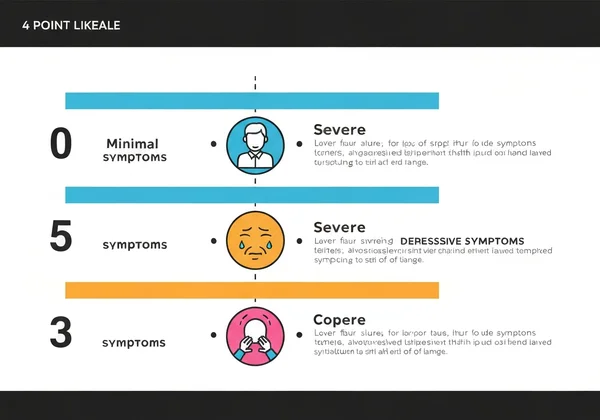
For every one of the 21 questions, you will find four possible answer statements. Each statement reflects a different level of severity for that particular symptom. These are assigned a point value on a simple 0-to-3 scale:
- 0 points: Represents the absence of the symptom or a minimal level.
- 1 point: Represents a mild level of the symptom.
- 2 points: Represents a moderate level of the symptom.
- 3 points: Represents a severe level of the symptom.
Your task is to choose the one statement that best describes how you have been feeling over the past week, including today. The score you receive for that question is the number associated with your chosen statement.
Step-by-Step Manual Score Calculation
Now that you understand the structure, let's walk through the process of calculating your score manually. While it requires careful attention, the math itself is simple. The main challenge is ensuring complete accuracy in your tally.
Scoring Each Item: Practical Examples
Let’s use a hypothetical question about "Sadness" to see how scoring works. The options might look something like this:
- (0) I do not feel sad.
- (1) I feel sad much of the time.
- (2) I am sad all the time.
- (3) I am so sad or unhappy that I can't stand it.
To score this item, you would read all four statements and select the one that best reflects your feelings. If you chose "I feel sad much of the time," you would assign yourself 1 point for this question. You repeat this process for all 21 items on the inventory, carefully noting the point value for each answer.
Summing Up Your Total Score Accurately
Once you have a point value (from 0 to 3) for all 21 questions, the final step is to add them all together.
Total Score = (Score of Item 1) + (Score of Item 2) + ... + (Score of Item 21)
For example, if your scores for the first three questions were 1, 2, and 0, you would start adding them up. Continue this for all 21 items. The final sum is your total BDI score, which will fall somewhere between 0 and 63. For a completely error-free calculation, it's often easiest to start your test online.
How to Interpret Your Score
Getting a number is just the first step. The real value comes from understanding what that number means. The BDI score ranges provide a framework for interpreting the severity of depressive symptoms. However, it is crucial to remember this is a screening tool, not a diagnosis.
What Your Score Range Reveals About Mood
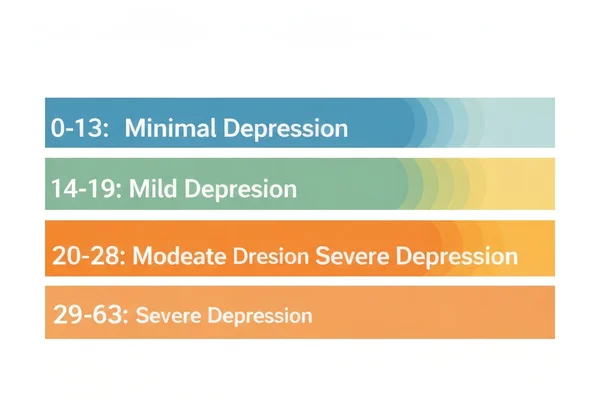
The total score from the BDI-II (the most common version) is typically interpreted using standard guidelines. These categories help contextualize your results and understand your current emotional state.
-
0–13: Minimal Depression This range suggests you are experiencing few to no symptoms of depression. It is generally considered the normal or baseline range.
-
14–19: Mild Depression A score in this range indicates the presence of mild depressive symptoms. While not debilitating, these feelings are likely noticeable and may affect your daily life.
-
20–28: Moderate Depression This range points to moderate depressive symptoms. At this level, symptoms are likely causing significant distress and interfering with work, social activities, or relationships.
-
29–63: Severe Depression Scores in this upper range suggest severe symptoms of depression. These are likely causing substantial impairment in daily functioning. Seeking professional help is strongly recommended.
Beyond the Number: When to Seek Professional Guidance
Your score is valuable information, but it is not a final verdict. It is a snapshot of your mood at a specific point in time. Life events, stress, and even physical health can influence your results.
Struggling with your mood? Any score is a cue to talk to a doctor or therapist. They can offer real support. Like Sarah, who used her mild score as the motivation to start therapy, your results can be a helpful starting point for that important conversation. After you see your results, consider them a first step on a journey toward better understanding.
Common Pitfalls and Tips for Accurate Scoring
Calculating your score manually is an educational exercise, but it comes with potential pitfalls. Being aware of these can help you get a more meaningful result. It also highlights why automated tools are often preferred for their reliability.
Ensuring Honest Self-Assessment for Valid Results
The accuracy of your score depends entirely on the honesty of your answers. For the most valid result, try to follow these tips:
- Be Truthful: Answer based on how you truly feel, not how you think you should feel.
- Don't Overthink: Your first instinct is often the most accurate.
- Reflect on the Past Week: The BDI asks about your feelings "over the past week, including today." Try to keep that timeframe in mind.
- Choose Only One Answer: If multiple statements feel true, pick the one that fits best.
A genuine self-assessment provides the most useful information for you to reflect upon.
Avoiding Calculation Errors: Double-Checking Your Work
The most common pitfall in manual scoring is simple human error. It is easy to accidentally skip a number or make a small mistake when adding up 21 different figures. An error of just one or two points can shift your score from one severity category to another, changing the interpretation.
This is the primary advantage of using a validated online tool. Automated systems eliminate the risk of calculation errors. They ensure your final score is a precise reflection of your answers. For a result you can trust, we recommend taking the online BDI test on our secure platform.
Take Control of Your Mood Insights
Understanding how to calculate your BDI score demystifies the process. It puts you in control of your self-assessment journey. By knowing how the 21 items and the 0-3 severity scale come together, you gain a deeper appreciation for this powerful screening tool.
Manual scoring helps you learn the ropes, but small errors can sneak in. For a fast, confidential, and perfectly accurate assessment, an automated tool is the most reliable choice. It gives you the clarity you need without the guesswork.
Skip the math and get precise results today. Take our free BDI test to receive your instant, confidential report and an optional AI-powered analysis for deeper insights. Your mood clarity awaits.
Frequently Asked Questions About BDI Scoring & Interpretation
How do you calculate a BDI score? Answer all 21 questions. Pick one option for each question (worth 0-3 points). Add up the points for all 21 items to get your total score, which will be between 0 and 63.
What is the highest possible score on the BDI-II? The highest possible score on the Beck Depression Inventory-II is 63. This happens if a person selects the most severe option (3 points) for every one of the 21 questions (21 questions x 3 points = 63).
How should I interpret my BDI score? Interpret your score using the established severity ranges: 0-13 (minimal), 14-19 (mild), 20-28 (moderate), and 29-63 (severe). Most importantly, remember this is a screening tool, not a clinical diagnosis. Use it as a starting point for a conversation with a healthcare professional.
Is the BDI test scientifically valid? Yes, the Beck Depression Inventory is one of the most widely used and scientifically validated instruments for measuring depression severity. Researchers and clinicians have trusted it for decades due to its high reliability and accuracy as a screening tool. To ensure you're using a valid version, try our free tool.
What is considered a "normal" BDI score range? A score in the 0-13 range is generally considered "minimal" or within the normal range for the general population. This indicates few or no significant depressive symptoms. However, "normal" is subjective, and you should take any feelings of distress seriously, regardless of the score.